If you are reading this, someone has likely asked you to write a eulogy and you need a clear plan — not a long meditation on grief, but actual steps you can follow tonight. This guide gives you exactly that: a five-step framework, a short eulogy template, a day-of delivery checklist, and a frank list of what NOT to say. Most people who follow this plan have a working draft within ninety minutes.
The five steps work whether you are writing for a parent, spouse, sibling, friend, or grandparent, and whether you have ten days or thirty-six hours. Start at Step 1 and do not skip ahead.
Before any writing begins, settle on a single sentence answer to this question: when the room walks out of the service, what is the one thing you want them to remember about this person?
Not three things. Not "everything they ever did." One thing.
Write your sentence at the top of the page. Every story you tell, every memory you include, every line you write must support that sentence. If a line does not support it, cut the line. This single decision is what separates a focused eulogy from one that wanders for ten minutes and lands nowhere.
Now go hunting for three specific, concrete moments that prove your sentence. Not summaries. Not "he was always kind." Actual scenes with details — a Tuesday night, a phone call, a kitchen, a car, a hospital corridor.
Sit down for twenty minutes and write down every memory that comes to mind. Then call two other people who knew the person well and ask them the same. You are looking for the moments that make people in the room nod, smile, or quietly cry — because the detail brings the person back into the building.
Choose the strongest three. One should ideally come from early in the relationship, one from the middle, one from the most recent years. That arc — without you ever announcing it — gives the eulogy a sense of a full life.
Test each story against your Step 1 sentence. If it does not prove your sentence, it does not belong, no matter how much you love it. Save those other memories for the reception.
Open a fresh document and write directly into this structure. Do not try to be original with the form — originality belongs in the stories, not the scaffolding.
Your name, your relationship, and a thank-you to the room for being there.
State your Step 1 sentence directly. "What I want to say about my mother is this: she made every house she lived in into a home within a week."
Open with a specific scene. End with a line that points back to your Sentence.
Same shape. A different decade or context.
Same shape. Often the most recent or most emotional.
Step back from the stories. Name what their life taught the room, or what the family will carry forward. Keep it concrete — avoid vague phrases like "she touched so many lives."
A direct line to the person, or a final line to the room. Stop there.
That is the whole eulogy. Roughly 700-900 words. Six to seven minutes spoken. Do not pad it.
A eulogy is a spoken document. It is not finished when it reads well on the page — it is finished when it reads well out of your mouth, at half-speed, with grief in the room.
Read it aloud at least three times before the day of the service.
First read: Catch the lines you stumble over. Rewrite them shorter and simpler. If a sentence is more than twenty-five words, break it in two.
Second read: Mark the spots where you tend to choke up. Plan a deliberate pause at each one. Write "BREATHE" in the margin if you have to. A pause is not a failure — it is part of the tribute.
Third read: Time it. Aim for six to eight minutes at the pace you actually speak under pressure, which is faster than your home pace. If you are over ten minutes, cut.
Print the final version in 14 or 16 point, double-spaced, with page numbers in the corner. Print two copies. Give one to a family member at the service as a backup.
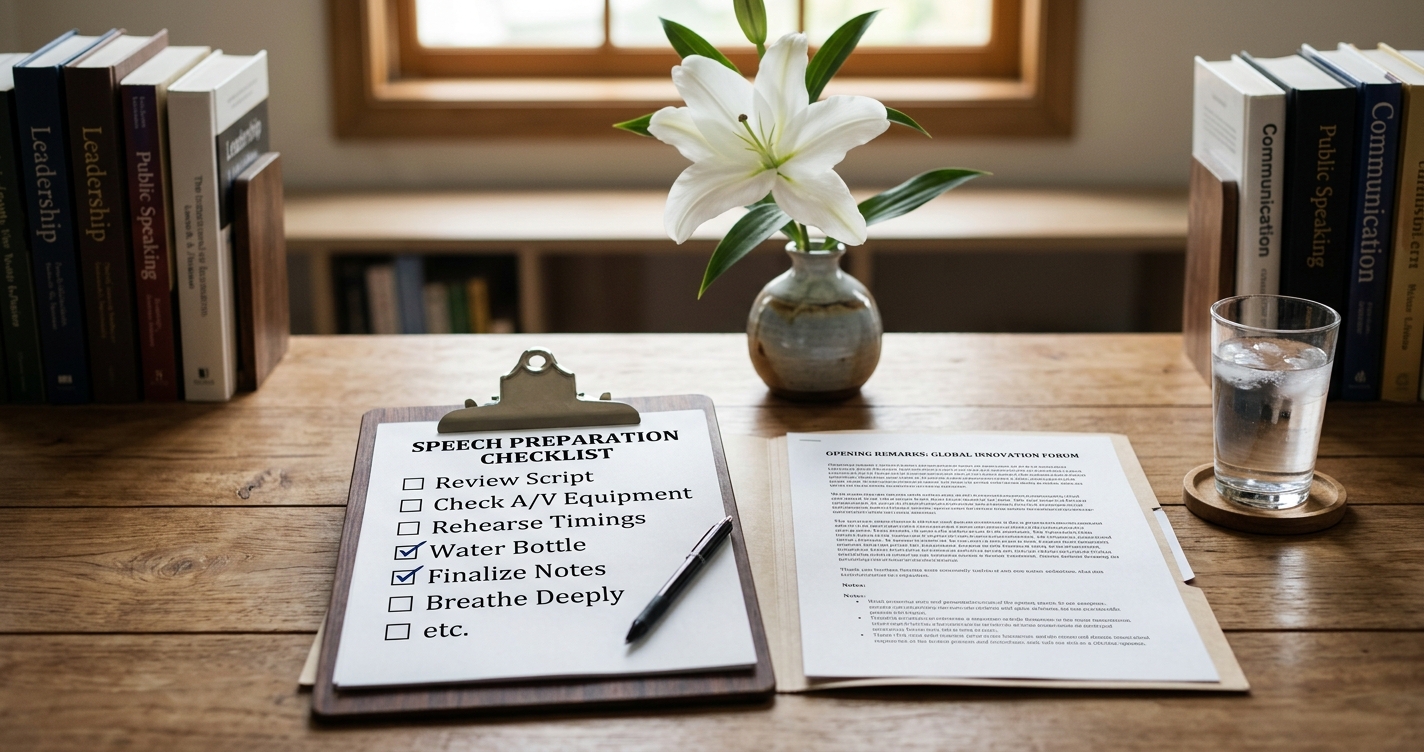
On the morning of the service, work through this checklist. It exists because grief breaks short-term memory, and you do not want to be improvising at the lectern.
When it is your turn, walk to the lectern slowly. Place your folder down. Take one full breath before you start. Read the first sentence to the room, not to the page. Then continue.
Almost every eulogy that misses the mark misses it in one of a handful of predictable ways. Avoid the following.
If you are out of time, fill in the blanks below. It will produce a respectful, four-to-five minute eulogy in under an hour.
For those who don't know me, I'm [your name], [your relationship to the person].
What I want to say about [their name] is this: [your Step 1 sentence].
One of the first memories I have of [them] is [specific scene, 3-4 sentences]. That was [their name] — [tie back to your sentence].
Years later, [specific second scene, 3-4 sentences]. They never made a fuss about it. They just did it, the way they did everything.
And in [their] last [years/months], [specific recent memory, 3-4 sentences]. Even then, [tie back to your sentence].
What [they] leave us is not a list of achievements. It is [the one quality]. We will carry that forward — in our families, in our friendships, in the small daily choices we make.
[Their name], thank you. We were lucky to have you.
Fill in the brackets. Read it aloud. Adjust the words until they sound like you, not like a template. You are done.
A short eulogy runs three to five minutes (about 400-700 words) and works well when there are multiple speakers or when the family wants a brief service. A long eulogy runs seven to ten minutes (about 1,000-1,400 words). Past ten minutes, attention drops sharply regardless of content.
Yes. Using the five-step framework above, most people produce a usable draft in 90 minutes and a polished version after one or two more sittings. The key is to decide on your single core sentence first, then build outward.
Arrange a backup speaker in advance — a sibling, adult child, or close family friend who has read your eulogy and is willing to finish it for you. Knowing the safety net exists usually means you will not need it, but having it removes the worst pressure.
For most people, no. Grief and adrenaline make improvisation risky, even for experienced speakers. Write the full text, print it large, and read from the page. Polished reading is far better than a memorized speech that falls apart halfway through.
It is a kind gesture, especially if you are mentioning specific family members or quoting the person directly. A quick read-through with one trusted family member can catch anything inadvertently hurtful and lets you adjust before the service.
The families who navigate a funeral most gracefully are not the most articulate ones — they are the ones whose loved one planned ahead. A pre-arranged service, clear final wishes, and a life insurance policy that covers costs let the family focus on writing the eulogy instead of scrambling to pay for the casket. Pre-planning is not about death. It is about protecting the people you love from preventable stress at the worst possible moment.
See if you qualify for affordable life insurance coverage in Canada. Takes less than 60 seconds.
Get a Free Quote